
Sensitivity: 105.1dB SPL/mW
Impedance: 12Ω
Frequency response range: 20~20kHz
Standard cable: Gold, silver and copper mixed braided cable
Connector: 2-pin
Plug: Detachable cable with 3.5mm, 4.4mm
Cable length: 1.2m
Total Score
Introduction
Greetings to all audiophile friends in the first week of May. Today, we’ll be reviewing an IEM featuring a fully balanced armature driver configuration with a stunning design. This is currently one of the company’s most popular IEMs. Here it is: the Aura from Moritz Audio.
Let’s see what kind of sound the drivers beneath this amazing faceplate produce.
The sample I have was provided to me by Moritz Audio for an independent review. I’d like to thank them here for adhering to our principles of integrity.
Before I started writing this review, I listened to the Aura for about 150 hours (excluding the burn-in period).

Design & Build
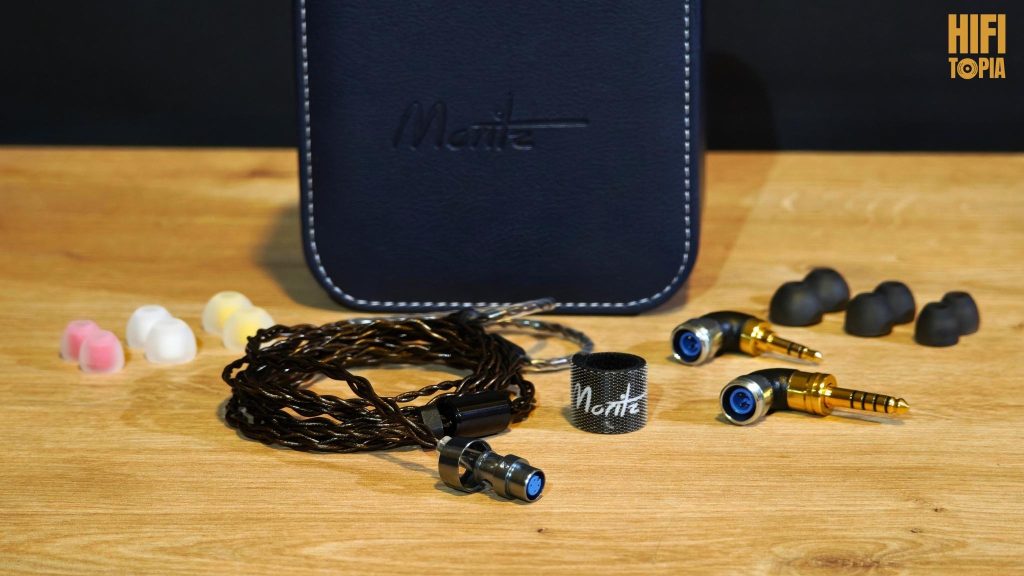
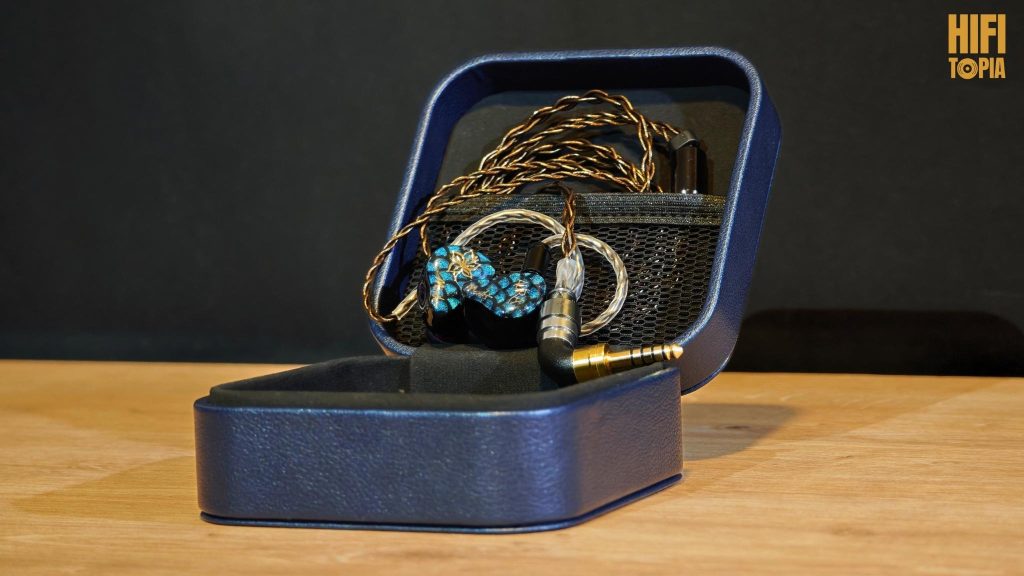
As I mentioned in the introduction, the most striking feature of these headphones is the faceplates. I’ll touch on this again in the section about the ear cups. The Aura comes in a medium-sized turquoise box with safety straps on the bottom. Inside the box, you’ll find an interchangeable cable with 3.5mm and 4.4mm jacks, as well as a total of six pairs of tips in two types and three sizes. There’s also a hard case that’s quite large and of good quality. Given their quality, these accessories are a great value for this price range.
The Moritz Audio Aura features a 3-way crossover configuration with 4 custom balanced armature drivers: 1 treble, 1 midrange, and 2 bass drivers. I want you to keep in mind that two of these drivers are dedicated to the bass section. Because you’ll read some positive things about this in the sound section.
Shells & Cable
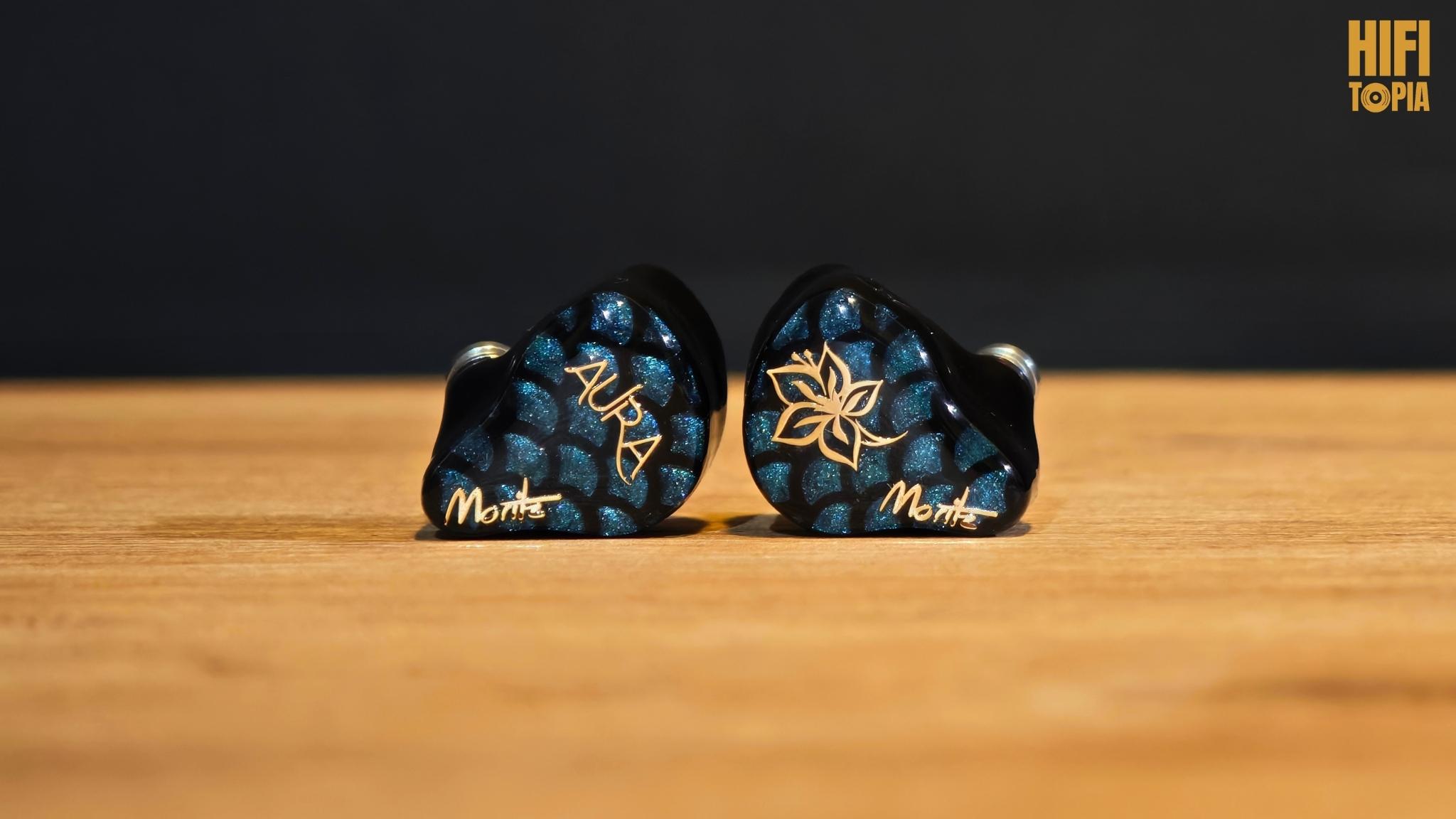
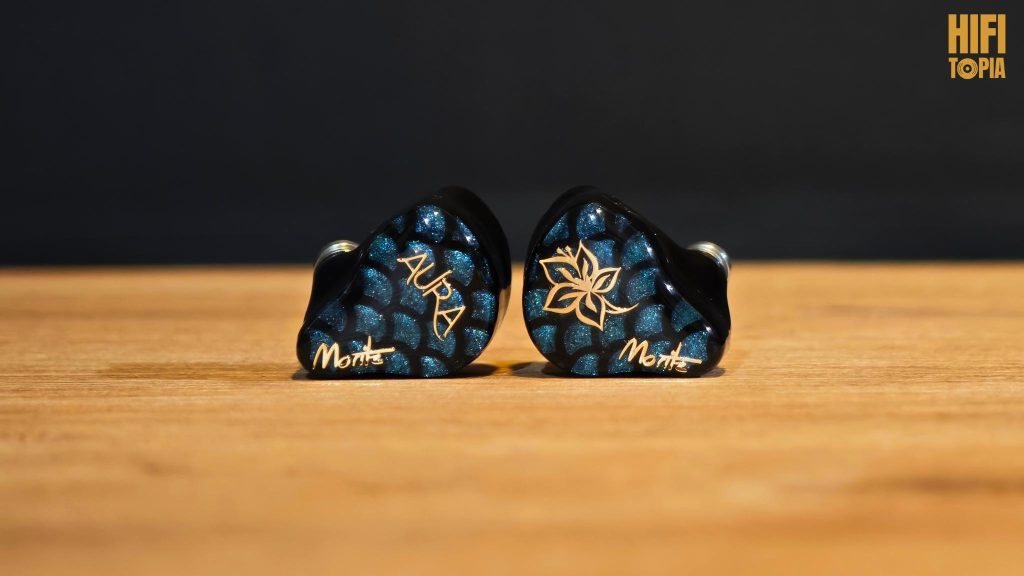
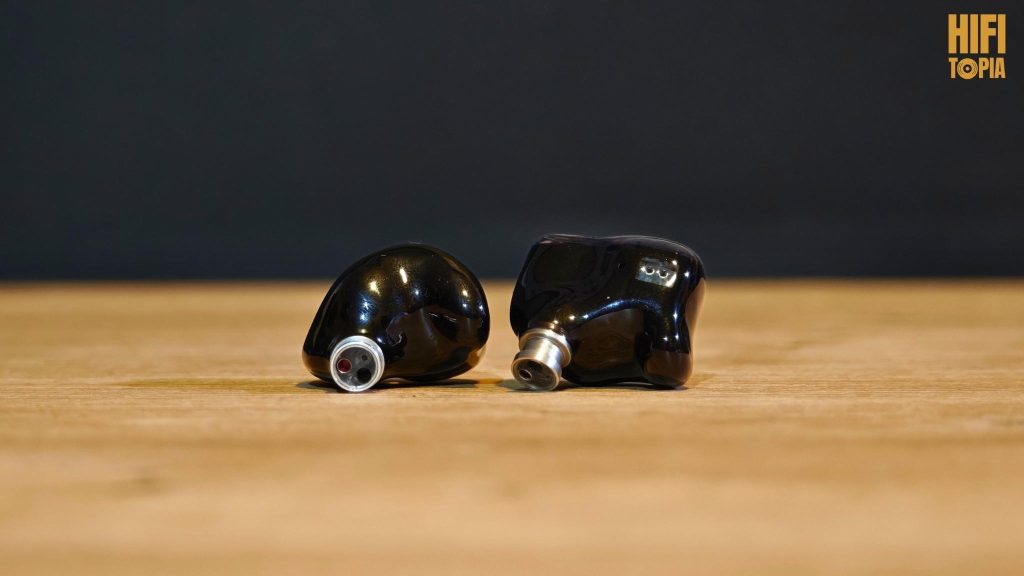
The shells, made from medical-grade resin, are average in size and ergonomically designed. They fit the ear very well. The isolation they provide is extremely satisfying, and they’re comfortable. The inner parts are black, and they feature stunning blue faceplates with a deep, rich appearance. On the left shell, the word “AURA” is written in gold, while the right shell features a very nice and minimalist flower design. Personally, I absolutely love this look—it’s both refreshing and eye-catching. When it comes to the nozzles, we see nozzles with a balanced length and no mesh at the ends. These are the nozzle tip designs that have become trendy recently: there’s no filter at the ends, and the filling material inside is directly visible.
It seems Moritz wanted to make a difference in the cable design here. The company, which states it uses a triple alloy of copper and gold, has incorporated a very sturdy jack replacement mechanism. This L-jack-style mechanism has received comments from some friends along the lines of “it looks very sturdy; that’s how a jack should be,” while others have called it “clunky and careless.” Personally, while I appreciate its functionality and durability, I found the design to be ordinary. The cable itself is somewhat thin and has 4 cores. It’s soft and doesn’t tangle, and there’s no microphonics.
Tips & Case
The Moritz Aura comes with 3 pairs of standard-thickness soft silicone tips and 3 pairs of silicone tips reinforced with internal foam. These silicone tips feature foam on their inner surfaces that does not come into contact with your ear or the canal inside the tip through which sound is transmitted. The plain silicone tips are the usual high-quality ones, but the foam-reinforced silicone tips are quite remarkable. They provide better isolation and add a new dimension to how you use the Aura. The hard case is exactly the kind I love—it’s high-quality and spacious. It’s covered in different materials on the inside and out, and features a small mesh pocket inside. It’s not only sturdy and high-quality but also eye-catching and stylish.
Synergy
The Moritz Aura features a tonal character that blends the musicality of U- and V-shaped profiles with an analytical timbre to create a hybrid sound profile. The result is a versatile yet synergistically selective tonal character. Before moving on to source pairings, let’s discuss the micro-synergistic elements:
First of all, you should know this: The Aura doesn’t start sounding quite right until it’s been burned in for at least 100 hours, and there’s a significant change in the sound. Everything really starts to come together. I’m mentioning this because I think it’s important to let users know this early on.
The sound I achieved with the foam-backed tips was generally a bit more laid-back and slightly more balanced compared to the stock tips. When I tested third-party tips, I found the best matches to be the JVC FX10 (not surprisingly) and the Divinus Prism.
In this section of the review, I listened exclusively through the 4.4mm port while using the stock tips and the JVC FX10. As with every synergy section, I’ll proceed from the cheapest to the most expensive.
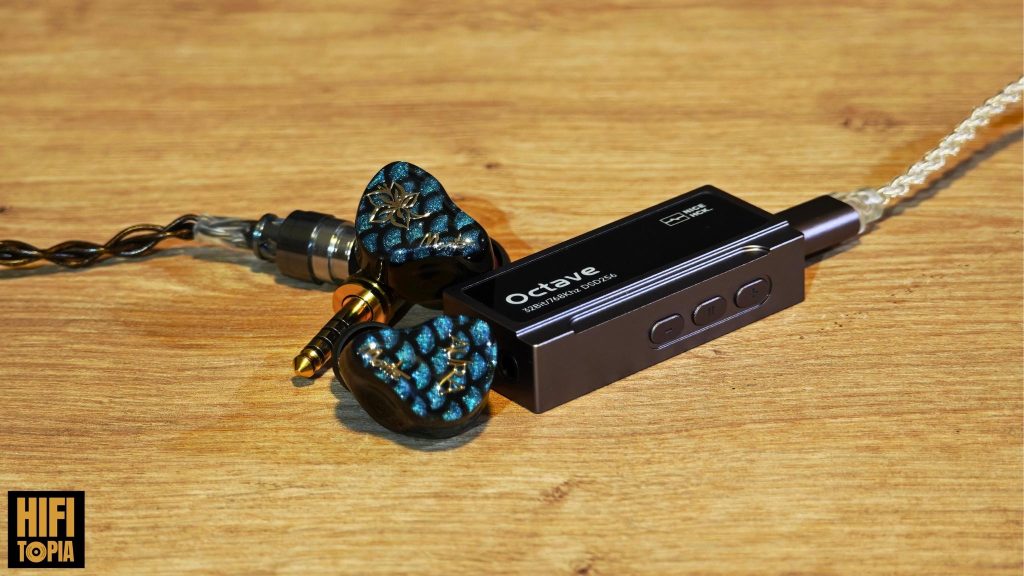
Moritz Audio Aura & Nicehck Octave
H gain, %30–35 volume.
The Nicehck Octave, which delivers incredible performance for its price and size, is a real standout in this pairing as well. The total setup cost for this duo comes in at around $500, and the technical performance you get is outstanding. The result is a dynamic, detailed, relatively balanced sound that pairs well with many genres of music. Tonally, the resulting sound profile reflects about 90% of the Aura’s own sound signature while also hinting at the body added by the Octave. The Octave is surprisingly successful at bringing out the Aura’s technical capabilities. Of course, it’s narrower and slightly more confined compared to its bigger siblings, but it still offers excellent separation and handles multiple instruments well. It’s a setup that makes you pause and think before spending a thousand dollars on a source. My score for this high-performance pairing is 9.5/10.
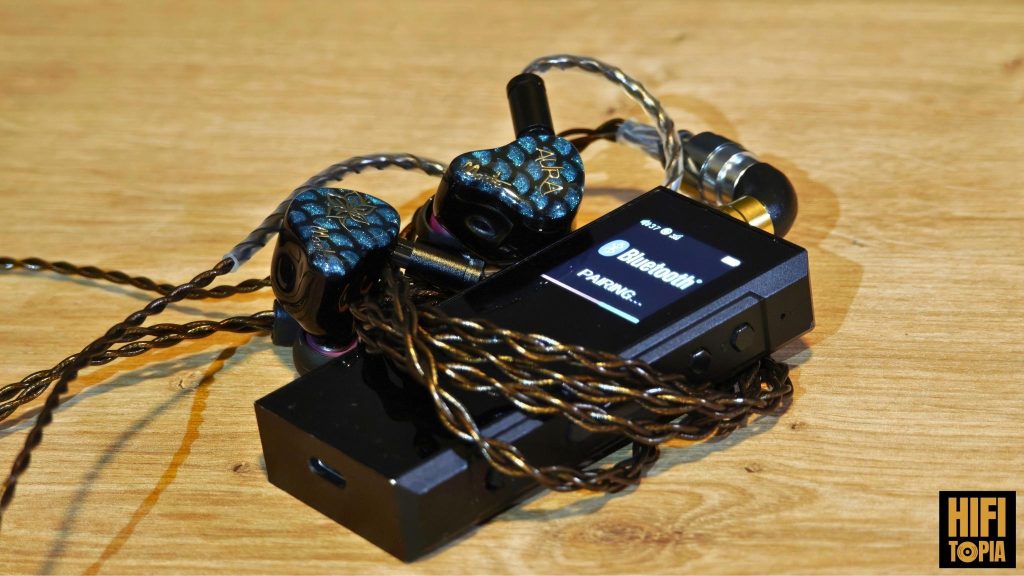
Moritz Audio Aura & FiiO BTR7
H gain, 23/60 volume, boost mode on, wired connection*
The BTR7, my personal favorite in the Fiio BTR series, is still going strong despite not being a current-generation device, and it certainly deserves a spot in this pairing. Its MSRP is slightly higher than half the price of the Aura. This makes the pairing reasonably balanced and a good benchmark. What about the resulting sound? It’s warmer, more organic, and crisper than the previous pairing. Here, the tonal profile is roughly 60–70% a mix of the Aura’s U and V profiles, while the remainder shifts toward the BTR7’s warm yet more mid-focused body. The resulting sound is a V-shape with colorations in the U and W-shaped profiles. The difference compared to the Octave is that, despite being fuller, it offers greater separation and a more laid-back presentation. The bass is quite deep and impressive, with a very realistic instrumental tone. From a technical standpoint, it offers roughly the same level of resolution as the Octave, but the BTR7 has more texture and delivers slightly higher accuracy. Taking the price-to-performance ratio into account, I give this pairing a 9/10.

Moritz Audio Aura & iBasso DX260mk2
M gain, 35–36% volume, Slow Roll Off
First of all, compared to Moritz Aura’s previous pairings, this one offers a much more refined technical performance. The resolution is so high, and the details are fully brought to the fore. The technical execution is consistent, and the soundstage and separation are much more pronounced. This pairing features a more natural sound character with a fresher, purer, and more realistic tone. Along with all this, this is one of the most energetic pairings I’ve experienced. The DX260mk2’s mid-centric sound and Moritz Audio Aura’s V-shaped profile achieve a fantastic synergy here, resulting in vocals that are slightly more forward and a musical, organic sound. This is also Aura’s least warm pairing: here, the balance shifts from the lower frequencies toward the upper-midrange, and frankly, this balanced profile is quite charming. Despite this, there’s a deep and full bass, and this duo achieves a state of balance where everything in the sound falls perfectly into place. I’m pushing the limits with orchestral performances and complex symphonic metal tracks, and the result is delightful. This pairing yields a far more impressive result compared to previous ones. Of course, since we’re pairing the Aura with a source that costs roughly twice as much, I expected a good result, but it also proved quite solid in a “synergistic” sense. My score for this pairing is 9.4/10

Sound
Tonality
Now let’s move on to the most enjoyable part of this review for both you, dear readers, and myself: the sound itself.
Let’s start by explaining in detail the tonal character I briefly mentioned under the “Synergy” heading. It’s essentially a V-shaped profile, though it shares some similarities with a U-shaped profile. The low frequencies are sub-heavy, full, and powerful, yet not overwhelming or too close to the surface. They’re fun but remain controlled. The midrange has a laid-back presentation but isn’t recessed; this is precisely where it feels like a U-shape because it offers sufficient transparency and clarity. When we reach the treble, there’s plenty of energy, yet it’s not piercing. Here, we observe a tone that is a perfect blend of V and U, because while the general treble body is forward like a V-shape, the internal balance of the trebles shifts toward the upper trebles like a U-shape. All of this leads me to interpret the Aura’s tonality as a V-U hybrid sound profile. The real question is: does the Moritz Audio Aura do this well? The answer is yes! This is a highly successful and unique tonal character. In some cases (depending on pairing or record) the treble might sound a bit sharp to someone, but other than that, I’d say the tonal character is exceptional. Especially before the burn-in process was fully complete, the treble was almost piercing, but after burning in for over 100 hours, the tonal character has settled down completely and is now quite good. Side note: I listened to at least a dozen IEMs during the burn-in process; your favorite reviewer is smart enough to account for perceptual factors 🙂
Bass
It’s time to put my thinking cap on. Frankly, if I hadn’t known that the Moritz Aura features a full balanced armature configuration, I could have sworn there was a dynamic driver here. It has a fantastic tone, with organic and powerful bass. It’s quite deep and perfectly placed in the soundstage. The extension is immense, stretching to its maximum natural limit—and it’s absolutely stunning. Plus, it’s musically satisfying: when I play “Jerry Was a Race Car Driver” by Primus, I hear a very textured bass guitar. The drum dynamics are also fantastic. Since the mid-bass is slightly recessed, it doesn’t shove all of this right in your face. Honestly, this is a fantastic combination for me. Its ability to capture fast drums is also excellent.
Mid
Transparent, full-bodied, detailed, and well-defined. There’s a very realistic sound here, and that’s no accident: when good technique and the right tone come together, the result is highly accurate and realistic instruments. I’m putting it through one of the toughest and most grueling tests possible and playing the piece “Allegro – Concerto in D minor.” I can clearly hear the guitars, strings, and extremely fast drums without any muddiness. Then comes a 16-minute feast: I play “Painters of the Tempest – Part II” by Ne Obliviscaris. Countless instruments, shifting rhythms, multi-layered vocals, violin solos, brutal sections, the bass-drum-guitar trio… and each delivers a satisfying result well above average. The Moritz Audio Aura offers far more than a simple V-profile, achieving this with a seamless, 4:4 midrange.
Treble
This is exactly where the excitement and contrast in the Moritz Aura’s sound come through: the treble. The Aura makes a perfect transition from the upper mids to the lower treble. Here, the transition is smooth and velvety, with no stair-step effect. As we move a bit higher, the volume increases slowly and in a controlled manner until we reach the main treble body. Here, emphasis takes precedence over a sense of intensity. This is good and exactly what we want. The trebles here are natural and well-tuned, and the amount of extension falls within the expected range. However, compared to the incredible success in the rest of the spectrum, the trebles are a bit more standard. Technically perfect, but while more precise nuances could have been incorporated here, a flatter transition to the air frequencies was preferred. Frankly, this is a very minor nuance, and I doubt many of you will even notice it, but I wanted to mention it anyway. Other than that, the treble is very successful in terms of overall airiness and placement, and they add a holographic feel to the soundstage in terms of spatiality. Accuracy in this area is above average, while overall realism is just average. As for the point where the air frequencies in the upper treble completely fade out, I found it quite natural and the amount of extension to be just right.
Technique
Actually, I inevitably delved into a lot of technical details in the sections above. That’s why I’ll keep this section generally informative and won’t go on too long.
Overall, in terms of resolution, detail reproduction, capturing nuances, and handling fast and complex passages, the Moritz Audio Aura is quite dominant and well above average. And all of these aspects—especially resolution—are remarkably homogeneous. The Aura handles power well and generally delivers an isobaric frequency response. However, for those who listen at very high volumes, there may be a slight boost at the extremes of the spectrum. Overall, it is isobaric enough to reproduce the source material clearly and maintain the same tonal character at different volume levels. When it comes to soundstage, the picture is quite promising: the Aura already has a laid-back presentation. It features a soundstage that’s quite deep, quite wide, and holographic. Its separation and layering are well executed, and it maintains this performance even with complex tracks. In terms of positioning, it’s generally successful and exceptional in some areas—especially its positioning in the lower frequencies is incredible. When it comes to accuracy, it performs well.
Last Words
The Moritz Audio Aura is a competitive, ambitious IEM that excels at so many things. I definitely think it’s worth trying out. The most important thing I’ll mention is that the burn-in process has a significant impact on this IEM. If I had reviewed it in its pre-burn-in state, believe me, this review would have been the exact opposite—so please let the Aura run for about 100–150 hours. I’ll mention this again at the beginning of the review because I’m talking about a dramatic change. Apart from that, it’s technically excellent and quite capable tonally. I’d just recommend that people with extremely sensitive high frequencies choose it carefully. Setting all that aside, it’s a much more versatile IEM than any V-shaped model, with exceptionally high instrumental capability, and it possesses nearly every advantage of a V-shaped profile. It’s a successful IEM.