Impedance: 50 Ω
Sensitivity: 110 dB/mW
Frequency response: 5 Hz – 50 kHz
THD: < 1% | Max. SPL: 125 dB
Weight: 270 g (wireless)
Clamping force: 4.2 N
Connection: Locking 3.5 mm (4-pole) input on one earcup; cable can be plugged into either earcup
Total Score
Introduction
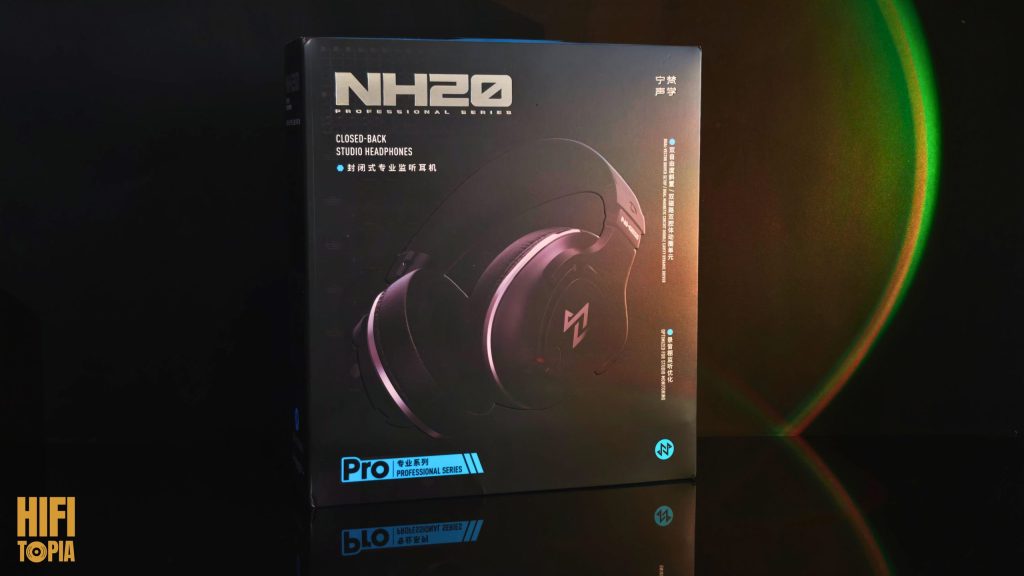
Greetings to all Hifitopia readers, and welcome to our NF ACOUS NH20 review. On these November days when the cold has really set in, we have on our desk the first over-ear headphones from NF ACOUS, a brand we’ve known until now only for its in-ear monitors: the NH20. These are closed-back headphones positioned as studio monitors. Let’s see what they have to offer when it comes to the pleasure of listening to music.
The product I have was sent to me by NF Acous for an independent review. We thank them for adhering to our principles of integrity.
Design & Build
Package & Cable(s) & Case
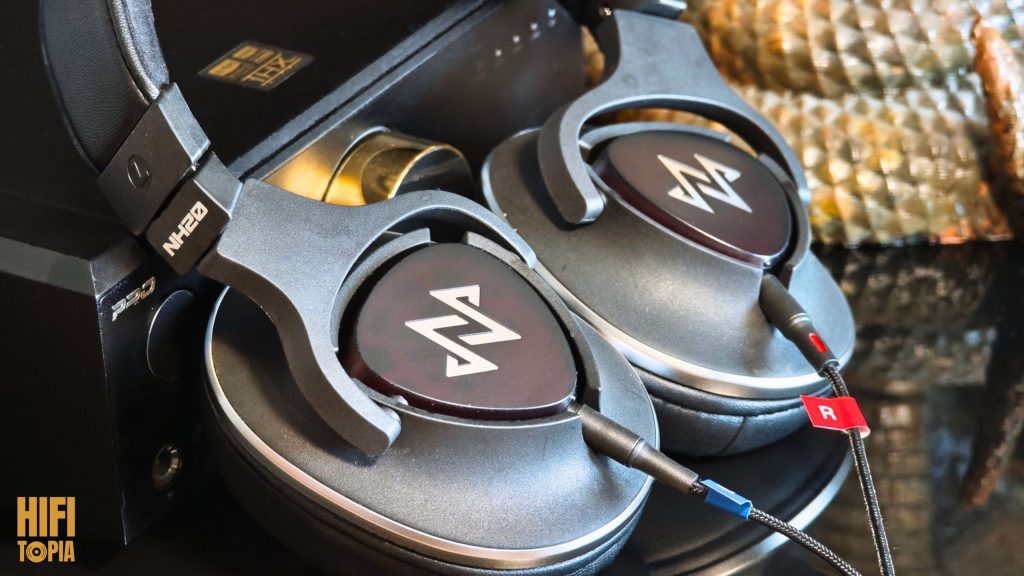
The box contents are functional but not cluttered: headphones, two 6N OFC copper cables (one 1.2 m, the other 3 m), a 6.35 mm adapter, a user manual, and a hard-shelled, zippered nylon carrying case. The case, which resembles an oversized guitar pick, is sturdy enough to withstand bumps and pressure. It comfortably holds the headphones and cables, and it even has a handle. The box doesn’t include spare ear pads, but we can’t really consider that a drawback at this price point.
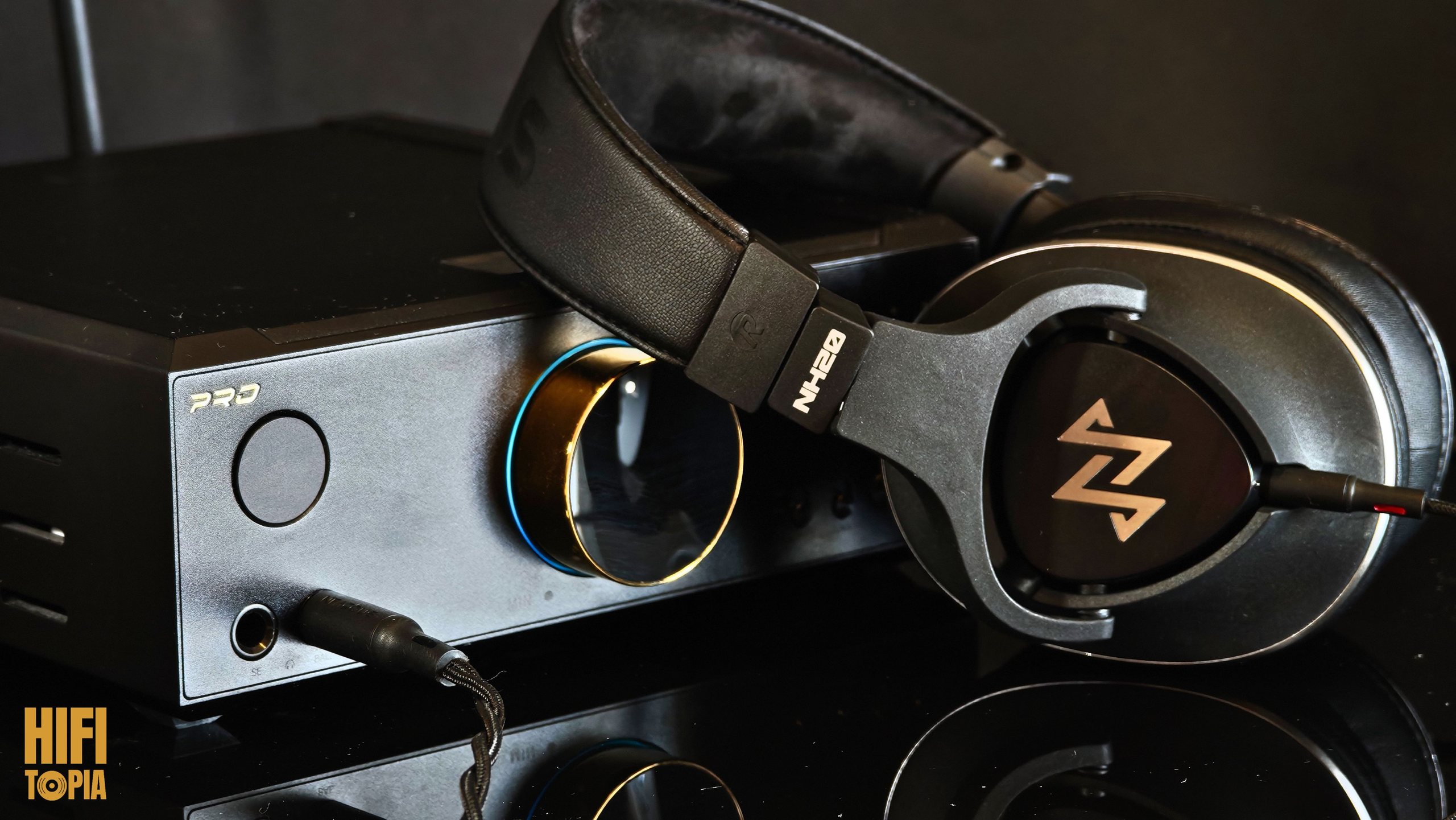
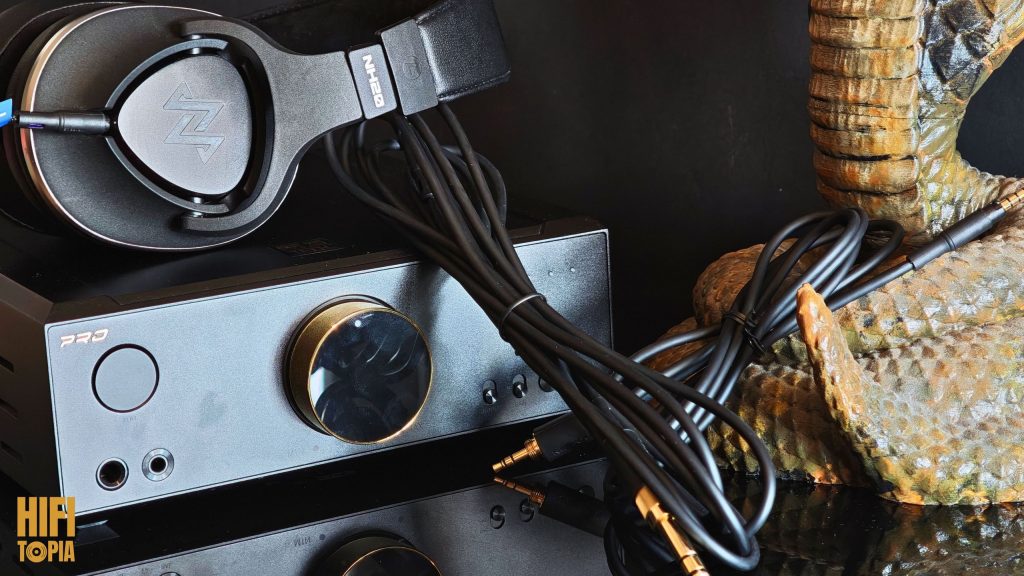
The included cable is soft and flexible thanks to its rubber coating. It has virtually no microphonic effect. The swivel lock mechanism at the connector prevents the cable from accidentally disconnecting during studio use. The left/right channel orientation is maintained regardless of which jack the cable is plugged into. Additionally, the company sent me a 4.4mm balanced cable. This cable is also sold for $40, and I strongly recommend purchasing it as I think the price is very reasonable.
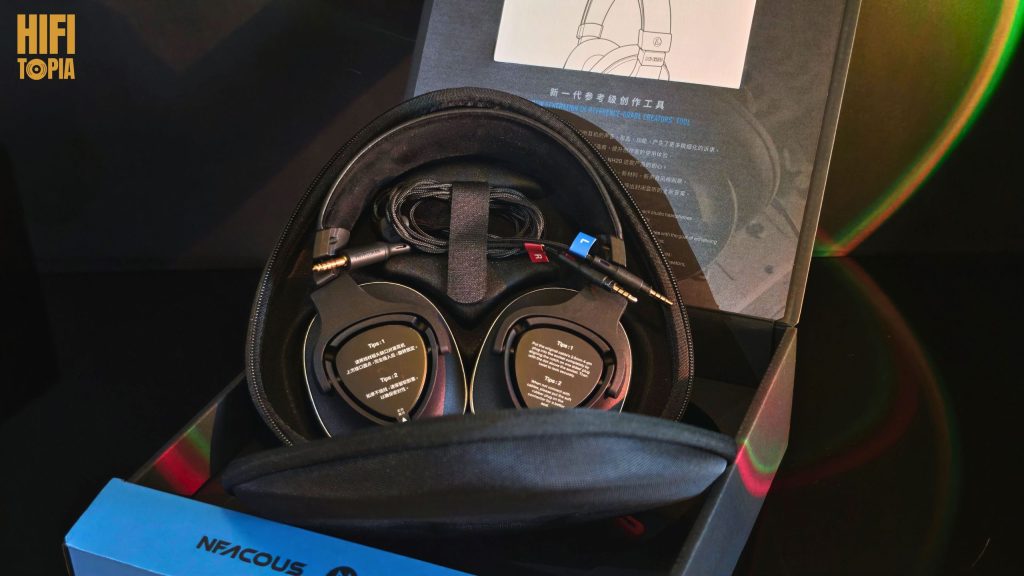
The NF Acous NH20 Review: Headphone Itself
The design reminded me of the Sony MDR-1AM2 🙂
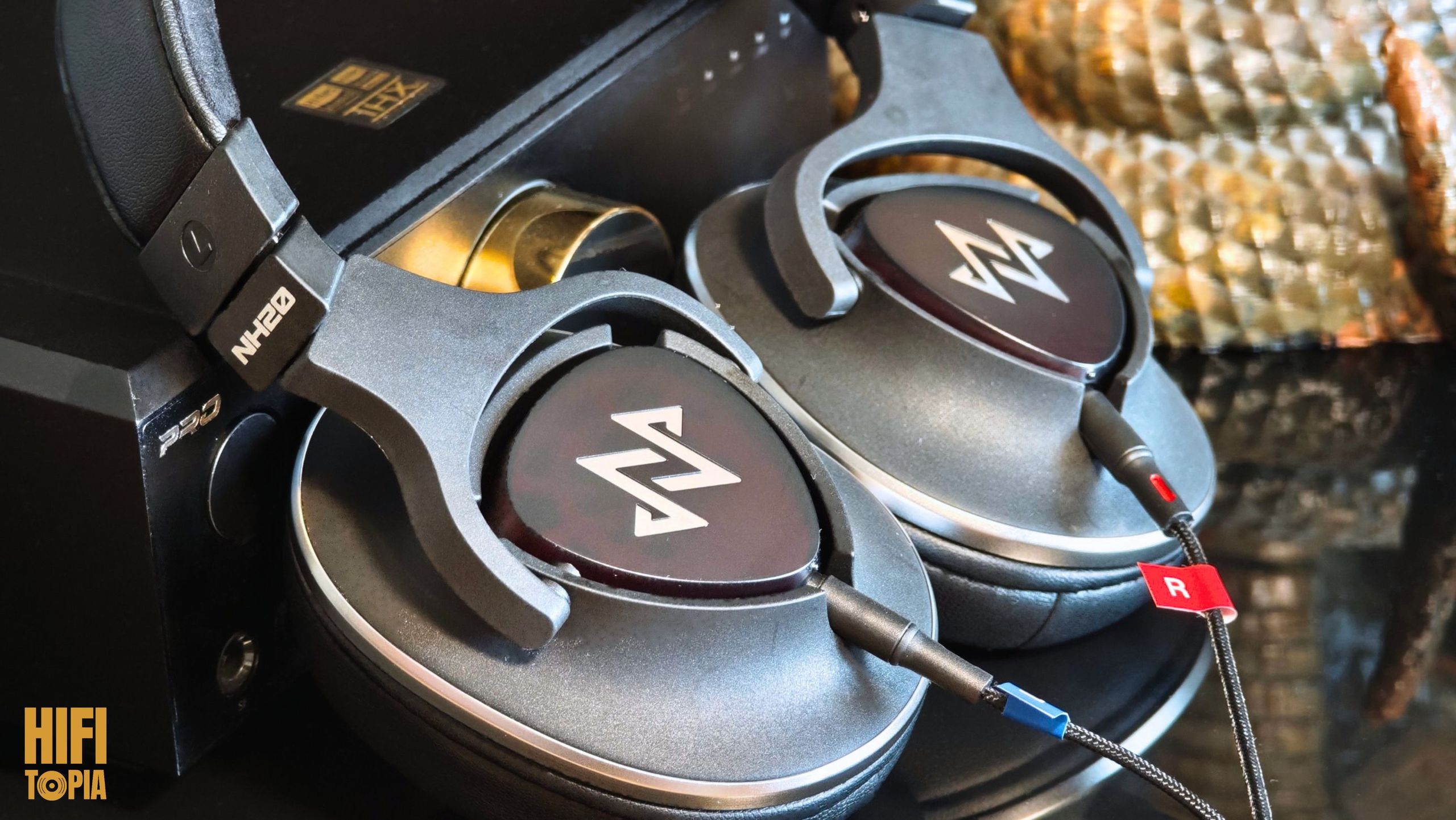
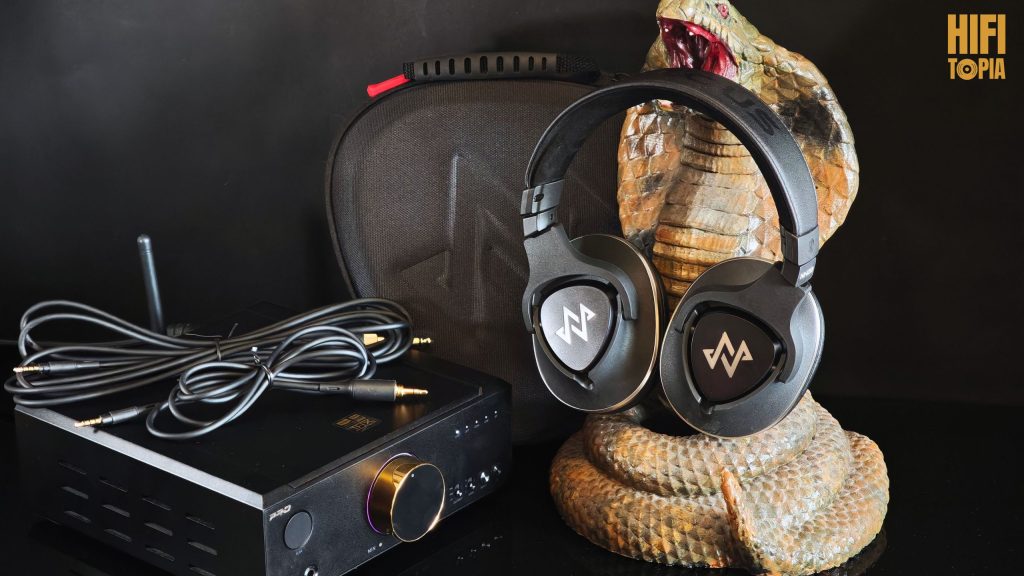
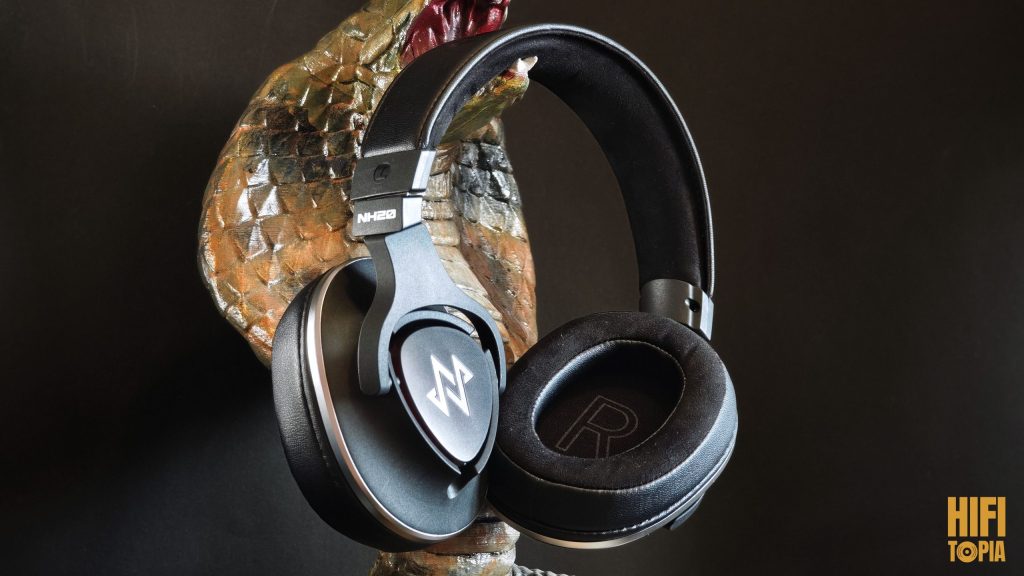
The body is largely made of high-strength plastic. Steel is used in the headband, and stainless steel in the hinges. It doesn’t creak or bend when forced to bend. However, it doesn’t have the “premium” feel of headphones with a metal body. It looks exactly like a tool: matte black, simple, with the brand logo and a triangular motif on the outer surface of the ear cups.
The plastic quality is quite high. The headband has 16 adjustment levels, which can be felt by touch. The ear cups rotate approximately 90° and stand upright, but they do not fold inward. As a result, they take up more space in a bag compared to compact, foldable headphones. The overall build quality has an industrial feel.
Comfort is one of the NH20’s strongest points. The ear cushions consist of a suede-like microfiber surface that feels like cashmere, hydrolyzation-resistant PU leather, and high-density, slow-rebound foam. The microfiber surface heats up the area around the ears less than all-leather cushions. The ear cup interior is spacious; even with large ears, they don’t touch the ear driver grille.
The clamping force is well-balanced: the headphones stay securely in place without squeezing the head. Even when worn with glasses for several hours, no pressure points develop. The claim that the PU coating is resistant to peeling can only be verified over the long term. Combined with its light weight, the NH20 felt quite comfortable to me for extended listening sessions.
Synergy
The NH20 is an easy-to-drive headphone with 50 Ω impedance and 110 dB/mW sensitivity. Even a simple dongle is enough to achieve a sufficient volume level. Of course, sufficient volume isn’t the same as full control. With a cleaner and more powerful source, bass control tightens up, texture improves, and the treble becomes more refined. In short, the NH20 responds noticeably to an amplifier.
The choice of cable also noticeably changes the sound. With the stock 3.5 mm cable, the trebles are more subdued and smooth; with the 4.4 mm cable, the soundstage widens and treble energy increases slightly, while the bass remains nearly the same.
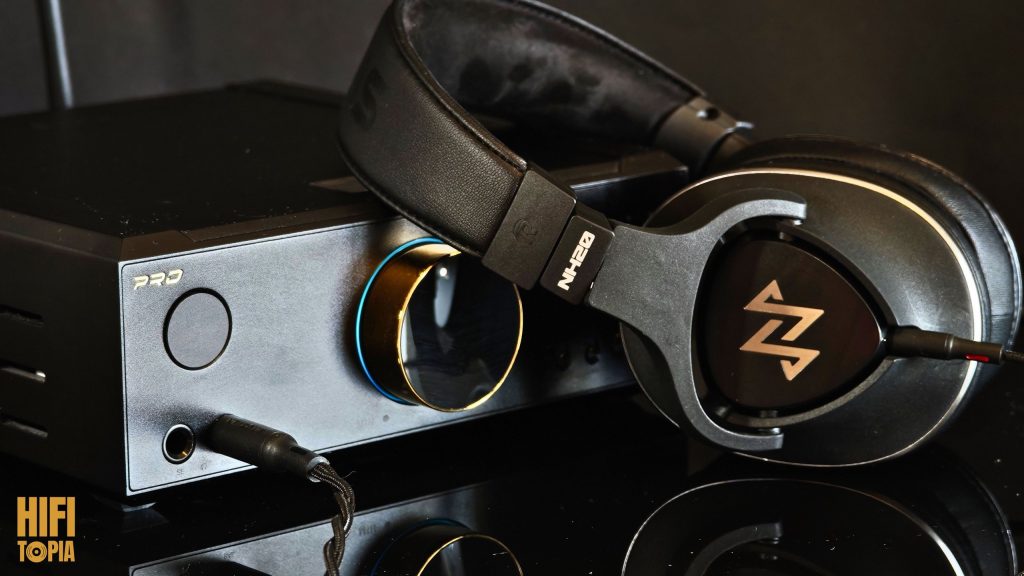
NF Acous NH20 & FiiO K9 Pro
Low gain – 4.4 mm balanced / 6.35 mm single ended
The K9 Pro is far more powerful than the NH20 needs. That’s why low gain is more than sufficient. The real gain comes not from power reserves, but from control. The background is completely black, the lower bass line is tighter, and the decay of the mid-bass impact is clearer. In fast electronic and metal passages, the bass notes are distinct without blending into one another. The K9 Pro’s clean and transparent character doesn’t soften the NH20’s upper-midrange energy; it conveys it exactly as it is.
As a result, the 2–4 kHz range becomes more prone to harshness at high volume levels. I particularly enjoyed this pairing on the Deftones track “Knife Prty.” For long listening sessions with this pairing, I believe a medium volume level is the better choice. With a balanced output, the soundstage widens while the treble energy increases slightly. For listeners sensitive to brightness, the 6.35 mm single-ended output and stock cable provide a more balanced result. Overall, while the sound retains a certain warmth, it’s a sound with a slightly colored tone.
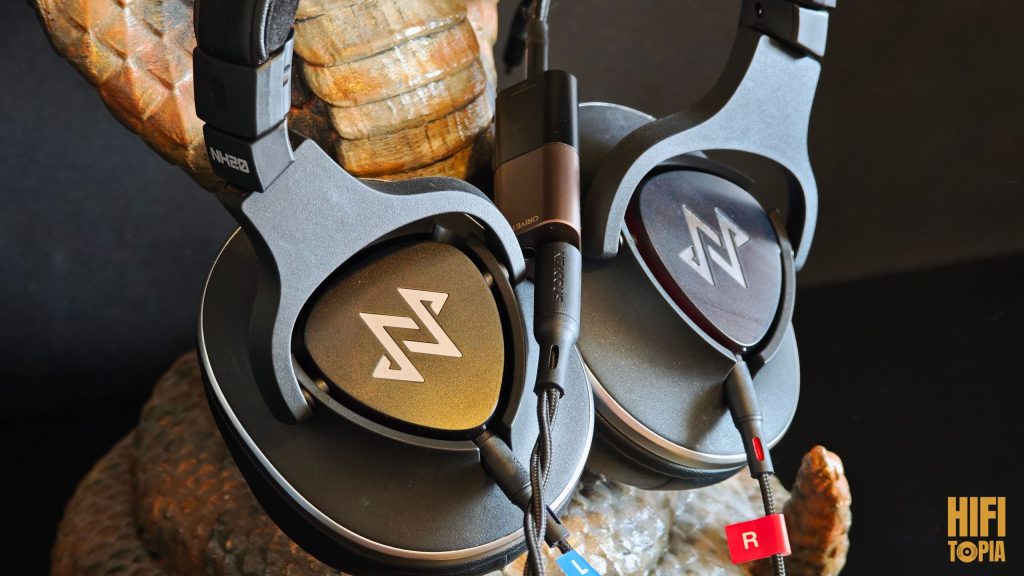
NF Acous NH20 & Oriveti Twin Revive
4.4 mm balanced / 3.5mm SE
The Oriveti Twin Revive easily brings the NH20 up to an adequate level for portable use. It reaches a listening-friendly volume level without utilizing most of the volume range. Compared to a desktop source, the difference is most noticeable in the bass: the low-bass control and mid-bass texture are a notch looser, and the dynamic separation is slightly tighter. Tonal balance is maintained in the midrange and treble regions. The NH20’s resolution and imaging capabilities remain largely intact even with the dongle.
The headphones truly showcase their full potential with a desktop source for users seeking tight bass control and maximum dynamics. The Twin Revive, paired with the NH20, produces a surprisingly excellent guitar timbre. I felt this wonderful timbre most strongly in Muse’s “Plug in Baby.” It’s hard to describe, but I’d say it feels authentic. On the go, the Twin Revive gets the job done without compromising the NH20’s character. All in all, this pair is a great match for the total price, offering a balanced sound profile across the entire spectrum and solid technical performance.
Sound
The NH20’s tonal signature is a neutral monitor tuning with a slight warmth. To be more precise, it features a moderate boost focused on the lower bass, layered over a neutral foundation. To describe the tonality, I’d use percentages like 85% neutral + 10% V-shape + 5% W-shape. The energy distribution across the frequency range is balanced. No frequency band overpowers the others, nor does it attempt to make poor recordings sound better: it rewards good recordings while clearly revealing the flaws in compressed or bright mixes. Since it features a single dynamic driver, there is no inconsistency caused by crossover transitions. The bass, mids, and treble blend seamlessly together.
The tone is largely natural. There’s no metallic glare in the treble. However, the tone occasionally comes across as a bit dry and analytical with acoustic instruments and live recordings. It doesn’t quite capture the liveliness of “a real instrument in the room.” I’d say it’s more detail-oriented than textural.
NF Acous NH20’s Bass
The bass is concentrated in the lower end. The rumble and vibration are felt more than they’re heard. The low bass reaches good depth for a closed-back design, but it doesn’t extend as far as bass-heavy headphones in the lowest octave. The mid-bass impact is full-bodied and springy; notes start quickly and finish cleanly. The texture is good. There’s no bloat in the 200–300 Hz range, and the bass doesn’t bleed into the midrange. These aren’t headphones for bass lovers. The bass isn’t there to dominate the mix, but to provide a foundation for it.
NF Acous NH20’s Mid
The midrange isn’t recessed; it has a strong presence. Instruments are easily distinguishable within the mix. There’s sufficient weight in the lower mids, and male vocals don’t sound thin. However, on some recordings, vocals can lack the expected body. There’s an increase in energy in the upper mids that I suspect is intended to bring vocals to the forefront. Female vocals are lively and bright, but in some recordings, this energy comes across as harsh rather than nuanced. There’s no harshness at low and mid volume levels. As the volume increases, this region becomes the NH20’s first point of fatigue.
NF Acous NH20’s Treble
In the lower treble, the attack is fast and sharp; there’s a distinct bite to the cymbals and hi-hats. There is no pronounced, distracting peak. The upper treble is open and airy for a closed-box design, extending all the way to the high frequencies without breaking up. Decay is fast; this enhances separation but slightly shortens the natural tail of the cymbals. The extensions are natural, and the timbre is authentic.
Technique
Resolution is the NH20’s strongest technical asset and remains consistent across the frequency range. Macro details are rendered with clarity. In micro details, the reverberations in the recording, panning decisions, and mix layers emerge effortlessly. The detail here does not stem from an artificial resolution achieved by over-polishing the highs, but rather from fast transient response and clean note boundaries.
The soundstage is successful in terms of width and height for a closed-back design. Depth is also sufficient. The central vocals and main instruments are positioned in a dense area close to the listener. As a result, the soundstage is perceived as a somewhat horizontal plane. However, the width remains consistent, giving the soundstage an airy feel. Positioning accuracy is consistent.
Stereo placement and panning are clearly discernible, and directional cues in games are easy to identify. Separation is generally very strong. However, in very crowded, fast-paced orchestral passages or those with heavy distortion, the shallow depth causes layers to compress forward, and separation narrows slightly. Overall, though, we see a headphone with high imaging capability for its price.
Last Words
Honestly, I really like these headphones. They’re well-built and lightweight, and the sound quality is much better than I expected just by looking at them. They have a versatile sound profile and excellent build quality for the price. I think they’re a great option for getting into over-ear headphones, and they’re suitable for both music and professional use. If I were still making beats like I did in high school, I’d take these for a test run, but I settled for just listening to music 🙂 We’ve come to the end of the NH20 review. I’d like to congratulate NF Acous on this great product. See you in the next review.